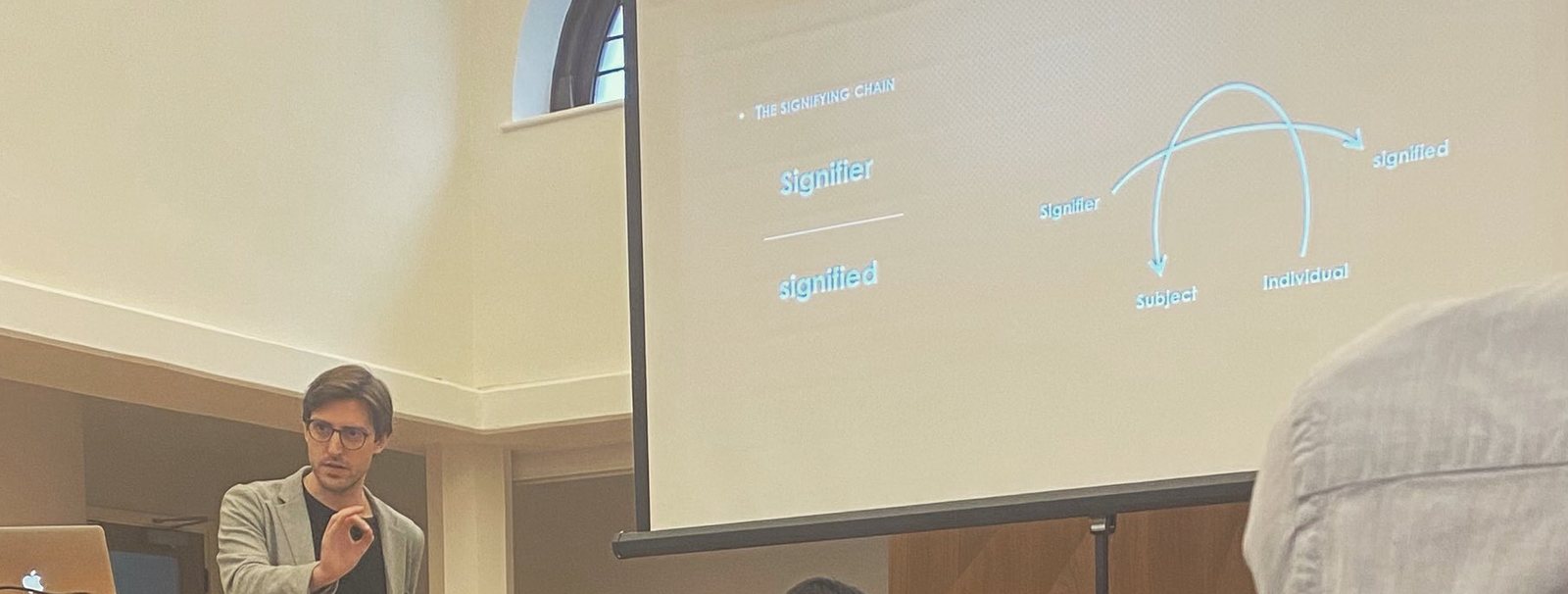

Presenting an early version of ‘The Politics of Civilian Suicidality’
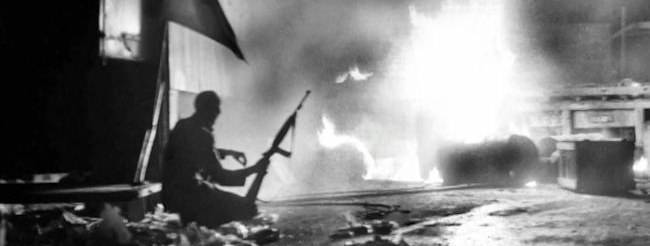
Joe McCann, Inglis’s bakery, the Markets, Belfast, 10 August 1971. Photograph: Ciaran Donnelly (Victor Patterson)
The Hours (2002), read in ‘Unsettling the Normal’. Still: Paramount Pictures and Miramax
Research
My research runs along three lines: the violence that peace processes cast off, from Northern Ireland to Colombia and Latin America; what critique can still do in international theory; and literature and popular culture as political theory.
Peace and violence
-
How does peacebuilding sabotage the peace it promises, and how is the surplus violence it casts off governed and disowned?
Doctoral thesis and the book project For the Greater Peace: Traumatopolitics and the Political Unconscious of Peacebuilding, in preparation
-
What is the political function of post-conflict civilian suicidality, and what does it reveal about the Northern Ireland peace process?
‘The Politics of Civilian Suicidality in Liberal Peacebuilding: Theorising the Death Drive in International Relations’, European Journal of International Relations, in press, 2026
-
To what extent does China’s peacebuilding contest the liberal script?
‘The Chinese Peacebuilding Script: A Pragmatic Contestation of the Liberal International Order’, SCRIPTS Working Paper No. 19, 2022
-
How does the war-peace binary obscure liminal violence?
‘Warpeace or the Missing Signifier of the International: On Liminal Violence and the Ideological Gaze’, work in progress
-
How does ideology shape post-paramilitary governance in Northern Ireland and Colombia?
‘Ideology and Post-Paramilitary Governance’, work in progress
-
Why do post-paramilitary groups turn to far-right vigilantism and social cleansing?
‘Who Watches the Watchmen? On the Liminality of Violence in Post-Paramilitary and Criminal Vigilantism’, a second project that won LSE funding for an Undergraduate Research Assistant Internship, 2026-2027
Critique and international theory
-
How can radical historicisation function as a form of critique, remapping ‘the critical’ in international studies?
‘Remapping the Critical: Imagining Anti-Hierarchical Futures in International Studies’, with Eva Leth Sørensen and Shreya Bhattacharya, Millennium: Journal of International Studies, 2024
-
How can critique be ethical when it abandons affirmative hope?
‘Ethics of Pessimism for Dark International Relations’, in Ignasi Torrent and Srishti Malaviya (eds), Dark International Relations: On Critique Beyond Affirmation, University of Michigan Press, forthcoming 2027
-
What becomes of critique once it gives up emancipation as a methodological promise?
‘Darkening Critical Theory: Enjoying Methodological Pessimism in the Negative Turn of International Relations’, Journal of International Political Theory, revised and resubmitted, 2026
Literary and cultural political theory
-
How does a vernacular peace, as in Derry Girls, reproduce the dominant story of the peace process even when it seems to challenge it?
‘“We’re the Goodies”—Lacanian Vernacular Peace: Ideology, Derry Girls, and Ontological (In)Security in Northern Ireland’, in Lee Jarvis, Michael Lister and Akinyemi Oyawale (eds), New Directions in Vernacular Security Research, Palgrave Macmillan, 2025
-
Can queer emancipation be non-linear, and what does a queer act unsettle about what counts as love?
‘Unsettling the Normal: Lacan, Woolf, and Queer Emancipation in Literary Political Theory’, Psychoanalysis, Culture & Society, revised and resubmitted, 2026
Doctoral thesis
Theorising the Death Drive in Liberal Peacebuilding: A Lacanian-Vernacular Analysis of Trauma, Surplus Violence, and Autoktonopower in the Northern Ireland Peace Process
Department of International Relations, LSE. Supervisor: Professor Mark Hoffman.
Fieldwork in Northern Ireland (2024-2026) and Colombia (2026), drawing on over 100 interviews.
Read the full abstract
In recent years, post-peace agreement societies have increasingly been governed through stabilisation policies aimed at preventing relapse into armed conflict. Northern Ireland is often treated as an internationally renowned ‘success story.’ However, segregation, political polarisation, and paramilitarism remain pervasive. Alongside this, a mounting mental health crisis and persistently high suicide rates further unsettle the dominant narrative of the peace process. While extant critical scholarship on liberal peacebuilding and statebuilding has shown how stabilisation measures prioritise a logic of conflict containment that permits the reproduction of ‘wartime’ orders during ‘peacetime,’ the structural conditions of this logic and its immanent effects require further exploration.
Drawing primarily on Lacanian psychoanalysis, and in dialogue with Althusserian structuralism and Mbembean necropolitics, the thesis problematises success-based accounts of peace processes by showing how peacebuilding undermines the peace it nominally seeks to promote through its structural aim of order containment and becomes a death-driven structure. A peace process’s failure to address trauma healing, reconciliation, and integration is not simply a consequence of ‘good enough’ peacebuilding but a structural condition for its continued reproduction of the sociopolitical order born out of conflict. Out of the subtraction between the negative peace achieved and the positive peace deferred, a surplus of violence emerges: institutionalised trauma, post-paramilitarism, and exposure to mental distress and suicidality. I conceptualise the governance of this remainder as autoktonopower, namely the post-conflict management of trauma and the differential distribution of liveability in contained spaces or communities. In the book, autoktonopower becomes one modality of traumatopolitics.
Through the study of post-Brexit Northern Ireland, the thesis employs a Lacanian and vernacular approach to discourse analysis, drawing on over 100 interviews alongside official governmental and non-governmental data and reports. First, it analyses the autoktonopolitical technologies of peacebuilding: the siloing of peacebuilding from mental healthcare and trauma healing through peace funding and peace bureaucracy, the grassroots offloading of responsibility, and the persistence of segregated education. Second, it examines the phenomenon of post-paramilitarism, how it emerges through development and reintegration funding projects and programmes and drug trafficking, appeasement and community policing, and the ideological regimes of normalisation and intelligibility that disavow it. Third, it shows how the psychological fallout of death-driven peacebuilding and post-paramilitary social control compounds with the institutionalisation of trauma and the privatisation of suicidality. Finally, the thesis applies the Lacanian peacebuilding framework and discourse analysis to the post-2016 Colombian case in order to stress-test the arguments of the thesis.